Could the Next Patient in Your ABA Practicum Be a Robot?
Robots are showing up in ABA training labs programmed to simulate real patient behaviors, including tantrums and self-harm, and AI is pushing their responses to become more lifelike every year. Here’s what this means for your training, your career, and where the field is heading.


Every college-educated, Board Certified Behavior Analyst (BCBA) has met stringent experience requirements in order to become an ABA therapist. Currently, that means completing 1,500 to 2,000 hours of supervised fieldwork, which may include practicum or internship experiences. That fieldwork involves direct assessment and treatment planning for clients across a variety of populations with a range of behavioral issues. It’s an essential part of developing and honing your skills as a therapist as well as becoming licensed.
The individuals you treat during this field experience are a sample of who you will interact with as a therapist: young and old, experiencing a range of mental or physical ailments, each with families looking to you for help.
But in the future, they may actually be robots.
That’s the hope at California State University Northridge’s KLab, at least, where researchers have been using small, cute, humanoid robots programmed with surprisingly lifelike behavioral issues to provide training simulations to study caregiver responses.
Robots in ABA Training: What’s Already Happening
When a Multimeter Is on the List of Suggested Classroom Materials in Your Next Behavioral Science Course
The Aldebaran NAO H-25 looks like it has stepped right out of a Star Wars movie, with wide eyes, a fixed expression, and colorful body highlights. But when programmed to simulate a child throwing a tantrum and self-harming, it can be stunningly lifelike and surprisingly disturbing.
This offers instructors the ability to tailor training encounters around the exact kinds of situations they want students to master. While dealing with human patients in-person will always be an important part of ABA master’s degree programs and experiential learning placements, it’s always a hit-or-miss environment for teaching specific skills. Therapists, even in training, must respond to the behavioral issues they are presented with. Those aren’t always what they need the most practice with, however.
The robotic simulation allows instructors to dial up the exact scenarios students must master. It also allows them to let students engage with situations, such as the self-harm scenario outlined above, that would be dangerous or unethical in the real world. And even though it’s a machine, seeing a robot throw a tantrum still comes with a more visceral impact than an instructor reading a scenario off a sheet of paper.
AI-Driven Robots Will Come With Lifelike Responses to Behavioral Training
With AI trained on behavioral data and simulated interaction patterns, these robots not only set an initial condition for students to respond to, but they can also realistically and dynamically react to different treatment methods.
The H-25 models come with tactile and pressure sensors and have speakers, microphones, and object recognition software. It can sense the therapist, hear what they are saying, and react autonomously. It will look at you when you’re speaking, reply to what you say, and even look like it’s blinking.
With more advanced AI packed into their little heads, in the future, those robots may be able to do even more, reacting to treatment just as real patients might.
The Large Language Models (LLMs) behind modern chatbots can already simulate conversations in various mind-states and at different ages and levels of development. Within a few years, you can see how those language skills could be dropped into an android and coupled with behavioral reactions for hyper-real training scenarios.
Today, robots are mostly used in research scenarios. But soon, they could be coming to a classroom near you as a training aid.
Your Expertise in Robotic Patient Treatment May Go Beyond the Classroom
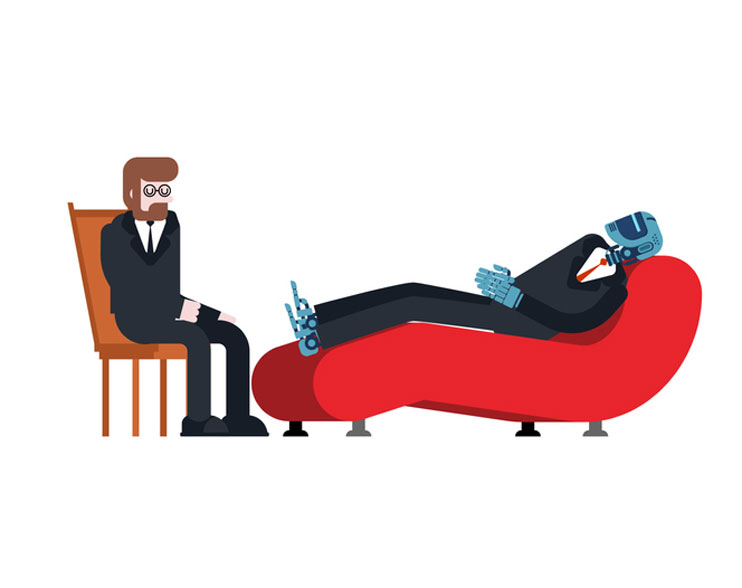
 If artificial intelligence is able to simulate patients in various stages of mental or physical distress, why not simulate therapists?
We’ve already discussed how AI is being used to improve the performance of ABA therapists in a variety of ways. Of course, this isn’t unique to ABA. This is an approach that is already seeing widespread adoption in the world of mental health therapy. Some of the oldest experiments with AI were in delivering talk-based therapy with human clients. Today, apps that can deliver cognitive-behavioral therapy and other treatment modalities without any active human therapist are popping up all over.
That’s not so different from almost any area in which AI is finding traction today. Companies are incorporating AI into everything from customer service to executive-level strategic decision-making.
There’s a common thread in all this, though, one that is easy for a trained behaviorist to spot: AI is being asked to adopt a set of behaviors in line with the expectations that people have for services in all these fields.
Applied behavior analysis is built around the antecedent-behavior-consequence (ABC) model. Consistent and predictable feedback, consequences, in response to a wide-ranging variety of patient behaviors are a hallmark, but that level of consistency and predictability still eludes AI programmers. ABAs working to train AI may offer the solution, though.
Appropriate Behaviors Are the Missing Ingredient in Modern AI
ABAs of the future might not only be developing their skills by training with robots: some of their clients out in the real world may be AI models, too.
Some AI developers are already incorporating behavioral data into their machine learning models to create more accurate and more effective machines. It’s not a common approach today because of the complexity of the data and interpretation.
But this is exactly what ABAs are trained to do.
Today, only the top AI development firms and research universities are hiring ABAs to dive into those mysteries. But as AI deployment becomes more widespread and corporations begin tailoring the tools to their own needs, it may not be long before behavior analysts are browsing job ads for Robot Therapy and Training.
Bringing Behaviorism to Machines Could Be the Next Frontier of ABA
That may open up an entirely new population for AIs to practice in. Their understanding of how human behavior works in practice may be the critical piece to building the theory that will allow AI to truly deliver useful and reliable results.
Along the way, they may unlock some new mysteries in human behavior, too. It turns out that humans themselves adjust their behaviors when training or interacting with AI versus when performing the same tasks with other humans.
Understanding how and why that occurs may be one of the keys to cultivating deeper AI/human partnerships and creating useful tools.
Getting the Education You Need to Meet the Future

As if it weren’t enough that ABA therapists have to master functional behavior assessments, play therapy, and CBT (Cognitive Behavioral Therapy), they may, in the near future, need to develop a whole new skillset: programming.
Behavioral Change Technology is already an important part of the curriculum at both graduate and undergraduate applied behavior analysis degree programs. Issues influenced by technology use, such as excessive gaming or social media-related behavioral challenges, may increasingly appear in clinical practice.
And ABAs have quickly adapted technology for various treatment purposes, too. There’s no reason the same training can’t go in the other direction. If you learn enough to use an app for patient treatment, then you probably already have a good idea how you might treat the app itself.
Could Robots in ABA Training Help Stem Job Losses Caused by Technology?
Of course, all this calls into question the future of ABA jobs and careers. Like any other profession that may be automated by AI, therapists have to wonder if they will be completely replaced by machines. That’s particularly true if they’re using their expertise to train the machines.
Robotics is one of the most complex AI technologies, as well as one of the riskiest, and it’s something that will take years of development to perfect.
Obviously, as the technology becomes more widely used, there will be shifts in the job market. But ABAs are uniquely positioned to benefit from their expertise in some of the most human qualities that AI might want to adopt.
Even as AI evolves, it’s most likely to evolve as a complement to human ABA therapists rather than a replacement. To that end, ABA students who have been trained by AI and in concert with robotic simulators may have a real edge in the job market. Once you’re familiar with the technology, it’s not just something that can teach you. It’s something you’re better able to use in your own practice.
Frequently Asked Questions
Are robots already being used in ABA training programs?
Yes, in some research and university settings, they are. California State University, Northridge’s KLab has been using humanoid robots programmed with realistic behavioral presentations, including tantrum simulation and self-injurious behavior, to train ABA students. It’s not yet widespread in standard programs, but the technology is advancing quickly.
What is the NAO H-25 robot, and how is it used in ABA?
The Aldebaran NAO H-25 is a small humanoid robot equipped with tactile and pressure sensors, microphones, speakers, and object recognition software. When programmed with behavioral simulations, it can react in real time to a therapist’s voice and movement. Researchers have used it to replicate challenging patient behaviors in a controlled training environment.
Could AI replace ABA therapists?
It’s unlikely, at least in the foreseeable future. Robotics is among the most complex and highest-risk areas of AI development, and real therapeutic relationships involve nuance that machines can’t replicate today. What’s more probable is that AI tools will work alongside behavior analysts, and therapists familiar with the technology will have a clear career advantage.
How does behavioral data improve AI models?
AI models trained on behavioral data are better at predicting and responding to human patterns. ABAs are trained to collect and interpret exactly this kind of data through observation, functional behavior assessments, and treatment tracking. That overlap makes behavior analysts a natural fit for AI development roles as the field matures.
What skills will future ABA therapists need because of AI?
In addition to core clinical skills, ABA therapists are likely to benefit from familiarity with Behavioral Change Technology, which is already part of many degree programs. Understanding how apps and AI tools shape behavior and being able to apply behavioral principles to technology design are skills that could open doors well beyond traditional clinical settings.
Key Takeaways
- Humanoid robots are being used in ABA training simulations at universities like CSUN, allowing instructors to create controlled, repeatable behavioral scenarios that would be difficult or unsafe to replicate with human patients.
- AI is making robotic training tools more dynamic, with LLM-based systems able to simulate conversations across different developmental levels and mind-states.
- Behavioral data is increasingly valuable to AI developers, and ABAs who understand how to collect and interpret it are positioned for emerging roles in tech as well as in clinical practice.
- ABA therapists are unlikely to be replaced by AI, but those familiar with the technology will have a meaningful edge, both in the job market and in their day-to-day practice.
- Behavioral Change Technology is already part of many ABA degree programs, giving students a foundation for working at the intersection of behavior science and AI.
Thinking about where an ABA degree could take you? Explore programs that prepare you for the future of the field, including the growing role of technology in behavioral practice.