Five of the most celebrated autistic visual artists include Stephen Wiltshire, Gilles Tréhin, Nadia Chomyn, Peter Howson, and Henriett Seth F. Each has been publicly identified as autistic or on the autism spectrum. And each created visual art so extraordinary it drew international attention, covering photographic-memory cityscapes to award-winning paintings and poetry.


We don’t often enough give people on the autism spectrum credit for the remarkable things they’ve accomplished. The word genius gets thrown around loosely in popular culture, but when you look at these five artists, it’s hard to find a better word. Their stories are different, their gifts are different, but what they share is extraordinary talent that, in some cases, autism may have helped sharpen.
Some researchers have explored whether certain cognitive traits associated with autism may contribute to artistic strengths in some individuals. Deep focus, pattern recognition, intense visual processing, and obsessive dedication to a single pursuit are among the traits that have emerged from that research. That’s not a universal claim, and autism looks different for everyone. But for the five artists below, the connection between how they see the world and what they put on paper is impossible to ignore.
Autism and the Visual Arts
Before diving into the profiles, it’s worth pausing on why autism and visual art intersect so often in these kinds of lists.
Many autistic individuals experience the world with heightened sensory detail. They may notice textures, proportions, and spatial relationships that neurotypical observers miss entirely. For some, this translates into an extraordinary ability to recreate what they see, or imagine, with near-perfect accuracy. For others, art becomes a primary mode of communication when spoken language is difficult or absent.
None of this means autism causes artistic talent. But the stories below suggest it can create the conditions for it.
5 Famous Autistic Visual Artists
1. Stephen Wiltshire
Stephen Wiltshire was born in the UK and diagnosed with autism in the late 1970s, at a time when ASD was still a relatively new concept in medicine. As a young child, he was nonverbal. His parents enrolled him in a special school, hoping he’d eventually learn to speak, read, and write.
Then one day in kindergarten, he said two words: “paper” and “pen.” His teacher handed them to him. He began drawing scenes from a recent field trip, and something remarkable became clear.
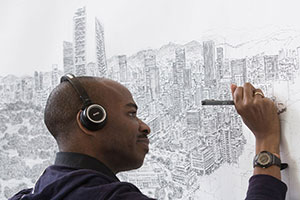
Stephen’s ability to absorb complex cityscapes and reproduce them from memory grew into what earned him the nickname “the human camera.” He’s best known for taking a short helicopter flight over a major city, then returning to his studio to draw, entirely from memory, a panoramic, architecturally accurate rendering of everything he saw. His work has been exhibited internationally, and he was appointed a Member of the Order of the British Empire (MBE) in 2006.
2. Peter Howson
Peter Howson was born in London in 1958 and raised in Scotland. He completed his first notable work at age six: a painting of the crucifixion of Christ. His formal artistic career began after art school, and his reputation grew steadily from there.
The BBC produced a documentary on his life, and in 1993, he was named the official British war artist for the Bosnian Civil War. He was also commissioned to design a British postage stamp in 1998. After receiving a diagnosis of Asperger’s syndrome (now classified under autism spectrum disorder) later in life, Peter became an outspoken advocate for autism awareness throughout Scotland and the UK.
In a video interview, he reflected that people tend to understand physical disability, but autism has taken much longer for the public to truly grasp.
3. Nadia Chomyn
Nadia was born in England in 1967. From the start, her parents sensed something was different. She was passive and unresponsive as an infant, and eventually received an autism diagnosis. At age three, when she still couldn’t feed or dress herself, she began drawing on the walls at home.
What she drew wasn’t the scribbles you’d expect from a toddler. She drew precise, proportional, perspective-accurate images of carousels and horses, inspired by her picture books. Between ages three and nine, she produced hundreds of drawings on whatever paper she could find: grocery receipts, scraps, notebook pages. Many of her works are preserved in museum collections.
Her case drew worldwide attention. She was the subject of international television documentaries and was studied extensively by renowned neurologist Oliver Sacks, who included her in his writing on neuropsychology. After age nine, her drawing ability mysteriously regressed and eventually disappeared. Nadia lived in a residential facility until her death in 2015.
4. Henriett Seth F.
Henriett was born in Hungary in the 1980s, during a period of significant political upheaval. For a child with special needs in that environment, support was nearly nonexistent. Medical care was limited, and intervention for a child with ASD was unlikely. She was refused entry to primary school because of her disabilities.
Despite all of that, Henriett emerged as someone often described as having savant-level abilities, with a reportedly high measured IQ. She’s sometimes called “Rain Girl” because of her striking similarities to the character in Rain Man. She went on to attend college, specialize in painting, and create prize-winning works exhibited in numerous galleries. She’s also an accomplished poet, musician, and writer. Her best-known work is the memoir Closed Into Myself, a personal account of her life with autism.
Her story is a reminder that even the most difficult circumstances can’t always contain extraordinary ability.
5. Gilles Tréhin
Gilles was born in France in 1972 and was diagnosed with autism in early childhood. At age five, when most kids are drawing stick figures with wobbly lines, Gilles was producing realistic, three-dimensional architectural work. He had delayed speech, was echolalic, and was extremely sensitive to sudden sounds like thunder, balloons popping, or a cracking whip. His first spoken word was “airplane.”
His mother recalled, “From 15 months, I knew he was different. But both Paul [Gilles’ father] and I, even before Gilles’ birth, liked people with different minds. So we always tried to see Gilles’ good points, and help him make the most of them.”
That encouragement may have contributed to one of the most remarkable creative projects you’ll find anywhere. Gilles began building a city out of Legos to support his Lego airport, but quickly ran into the physical limits of the medium. So he started drawing instead. He’s now been drawing his imaginary city, Urville (set on an island off the Côte d’Azur), for more than 3 decades, sometimes for up to 10 hours a day.
What makes Urville extraordinary isn’t just the artistic precision: it’s the depth of the fiction. Gilles has created a detailed history of the city going back to the French Revolution. His work has been compiled in the book Urville, featuring hundreds of his illustrations.
Frequently Asked Questions
What makes autistic artists different from other artists?
There’s no single answer, but researchers have noted that some autistic individuals have exceptional visual processing, heightened attention to detail, and an intense, focused dedication to a single pursuit. For artists like Stephen Wiltshire and Gilles Tréhin, those traits translated directly into artistic abilities that most people can’t replicate. That said, autism is a spectrum, and these traits don’t apply to every autistic person.
Are all of these artists autistic savants?
Not all of them. Some, like Henriett Seth F., are often described as having savant-level abilities alongside significant challenges. Others, like Peter Howson, built successful careers through dedicated practice and artistic training rather than emerging with spontaneous savant-level skill. The common thread is autism, not savantism.
Are there other famous artists who may have been autistic?
Yes, several historical figures have been discussed in this context, including Michelangelo. Some historians and medical scholars have speculated that his described behaviors are consistent with what we now understand as ASD, though such retrospective diagnoses remain controversial and unprovable. The conversation is worth having, but conclusions should be held loosely.
Why did Nadia Chomyn lose her ability to draw?
Researchers and clinicians have studied Nadia’s case extensively, and no consensus explanation has emerged. Some researchers have discussed the timing of her regression in relation to language intervention, though no causal link has been proven. Her case remains one of the most studied in neuropsychology.
Can ABA therapy support creative development in autistic children?
Families exploring support options may consider a range of therapies, including ABA, occupational therapy, speech therapy, and arts-based interventions. ABA therapy focuses primarily on communication, social skills, and adaptive behavior, but its principles can support any goal a child and family identify as important, including creative expression. A skilled ABA practitioner can help reduce barriers to engagement and create the conditions where interests like art can flourish. If you’re considering a career supporting autistic individuals, you can explore top ABA master’s programs to get started.
Key Takeaways
- Stephen Wiltshire, Gilles Tréhin, Nadia Chomyn, Peter Howson, and Henriett Seth F. are five internationally recognized artists who have each been publicly identified as autistic or on the autism spectrum.
- Some researchers have explored whether certain cognitive traits associated with autism — deep focus, exceptional visual processing, and intense dedication — may contribute to artistic strengths in some individuals, though this doesn’t apply universally.
- These artists represent wildly different backgrounds, countries, and circumstances, showing that autism’s connection to artistic talent doesn’t follow a single pattern.
- Nadia Chomyn’s case remains one of the most studied examples in neuropsychology due to her early abilities and later regression, with no proven explanation for what caused it.
- Gilles Tréhin has spent more than three decades building an imaginary city through drawing, working up to ten hours a day — a dedication that mirrors the intense focus often seen in autism.
If you’re inspired by the potential of people with autism and want to learn more about the field that supports them, exploring ABA programs is a great place to start.