The early signs of autism in children typically appear in the first one to two years of life and fall into four main categories: communication difficulties, social skill delays, unusual behavioral patterns, and sensory sensitivities. No single sign confirms autism, but a consistent pattern across multiple areas is worth discussing with your pediatrician or a developmental specialist.


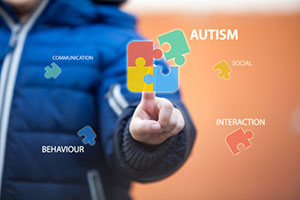
If you’re asking, “Does my child have autism?” you’re probably not asking casually. Most parents who land here have seen something that caught their attention, maybe a lack of eye contact, a strong reaction to noise, or a speech delay that feels like more than typical variation. That kind of parental instinct is worth taking seriously.
Here’s what we know after years of covering ABA and autism research: early identification matters enormously. The sooner a child is evaluated, the sooner they can access early intervention services that make a real difference in communication, social skills, and behavior. You don’t need a diagnosis to start paying attention. You need to know what to look for.
This guide breaks down the most recognized early signs of autism spectrum disorder in children, explains what they look like in everyday situations, and helps you decide when it’s time to talk to a professional.
What Are the Early Signs of Autism in Children?
According to the National Autism Association, signs of autism in children typically appear through some combination of four core areas: difficulty with social interactions, cognitive differences, communication challenges, and repetitive behaviors.
No single behavior confirms autism. Every child develops at their own pace, and plenty of neurotypical children show one or two of these traits without any underlying diagnosis. What matters is whether you’re seeing a consistent pattern across multiple areas, especially as your child approaches the developmental milestones where these differences tend to become more visible.
It’s also worth knowing that CDC surveillance data has found that a significant portion of individuals on the autism spectrum have average or above-average intellectual ability. However, estimates vary and can’t be generalized to all autistic individuals. Autism looks different in every child.
Sign 1: Sensitivity to Sounds and Sensory Input
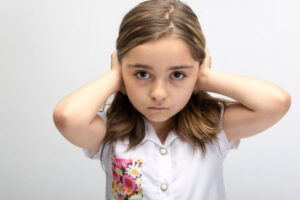
Children with ASD often have a much stronger reaction to sensory input than you’d expect. Loud noises are the most common trigger, but the sensitivity can extend to textures, lights, tastes, and smells.
What this looks like in daily life: your child grimaces or winces when the TV volume goes up, has a meltdown when you run the vacuum cleaner, or gets distressed when other kids are playing loudly nearby. While most children eventually adapt to background noise, children with autism can struggle to filter it out. The microwave beeping or the washing machine running, sounds that fade into the background for most people, can feel completely overwhelming.
This sensory sensitivity can show up as fits, crying, anger, or even physical aggression. It can also run in the opposite direction: some children with ASD show no response to sounds that would normally startle or surprise a typical child. Both extremes are worth noting.
ABA therapy is particularly effective for sensory processing disorders, whether they’re part of an ASD diagnosis or a standalone concern.
Sign 2: Trouble With Eye Contact and Facial Expressions
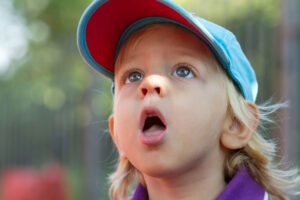
From very early in life, most children learn to make eye contact, smile back when they are smiled at, and point to things they find interesting. These instincts are social glue, and they develop almost automatically in neurotypical children.
Children on the autism spectrum often have a harder time with this. They may avoid eye contact, fail to look up when you enter a room, or not track your face the way you’d expect. One specific thing to watch for: when something startling happens, most young children will immediately look at a parent’s face to gauge whether they should be worried. Children with ASD often skip this social referencing entirely.
Older children with ASD, roughly ages three to five, will sometimes look at the floor or let their eyes wander when an adult is speaking directly to them. They may also miss emotional cues in facial expressions, reacting inappropriately or not at all when a family member is clearly happy, upset, or hurt.
Sign 3: Speech and Language Delays
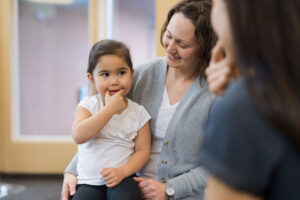
Communication differences are one of the earliest and most commonly noticed signs of autism in children. However, they can also be some of the trickiest to interpret because children develop language at different rates.
A few specific patterns are worth looking for. By 12 months, most toddlers say “mama,” “dada,” or another special name for a parent. By 18 months, CDC notes most children try to say three or more words beyond those names and point to show you something interesting. Children with ASD may lag behind these milestones significantly.
Another pattern that parents often describe: their child babbled and cooed normally in the first few months of life, and then stopped. All language experimentation abruptly ceases. This regression in communication is often an important signal that something more is going on.
Even when children with ASD do speak, they may repeat unrelated words or phrases without using language to communicate a real thought, need, or feeling. You might also notice a consistently flat or sing-song voice, difficulty with pronoun use (referring to themselves as “you”), or trouble following a back-and-forth conversational thread as they get older.
Early intervention is key here. Whether a child ultimately communicates through spoken language, sign language, or an augmentative communication device, starting therapy early gives them the best foundation. Here are 7 tips for communicating with children with ASD that parents and caregivers have found helpful.
Sign 4: Limited Interest in Social Interaction

For most young children, the world is a constantly exciting place full of things to explore and share. They’ll drag you over to look at the dog across the street. They’ll thrust their drawings in your face for approval. They’ll watch other children with fascination and eventually try to join in.
Children with ASD often respond differently. They may not turn toward you when you say their name. They might not point at objects, seek your attention, or show you things they find interesting. Where a neurotypical child uses shared attention as a way to connect, a child with ASD may not engage in that kind of back-and-forth.
Pretend play is another early indicator. Most young children will start imitating adult behaviors, such as pretending to cook, holding a toy phone to their ear, and feeding a doll. Children with ASD often don’t engage in this kind of imaginative imitation, or do so much later than expected.
Social interest in other children can also be reduced. Even toddlers typically react to other kids with curiosity, excitement, or a little shyness. A child who seems entirely indifferent to other children, who doesn’t watch them, approach them, or react to them at all, may be showing one of the early social signs of ASD. Some children with ASD also have strong adverse reactions to physical contact, including hugging, hand-holding, or being picked up.
Sign 5: Unusual Behavioral Patterns
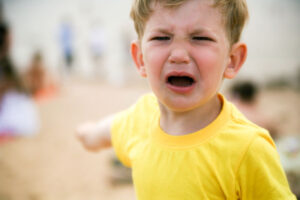
For many parents, it’s actually the behavioral aspects of autism that first signal something is different, sometimes even before speech or social delays become obvious.
Common behavioral signs include repetitive physical movements such as arm flapping, jumping, or rocking, strong fixations on specific objects or topics, rigid attachment to routines, distress when anything changes, a very short attention span, and hyperaggression. Difficulty making eye contact also falls into this category and often overlaps with the social signs described above.
It’s worth being clear: any one of these behaviors on its own is not a diagnosis. Lots of kids flap their arms when excited, or go through phases of intense fixation on a specific toy or topic. The question is whether these behaviors are persistent, intense, and part of a larger pattern that’s affecting daily life and development.
At What Age Does Autism Usually Show Up?
Early signs of autism often appear in the first one to two years of life, sometimes by 12 to 18 months or earlier. That said, milder presentations are often not recognized until a child starts school and begins showing difficulty with social situations or learning.
According to the CDC, a diagnosis by an experienced professional at age 2 can be considered very reliable. The CDC’s Learn the Signs. Act Early. The program offers free resources and tools to help parents identify potential developmental concerns earlier and navigate the path toward professional evaluation.
When to Talk to a Doctor
No combination of behaviors on this list constitutes a diagnosis, and you don’t need to be certain before reaching out. That’s what the evaluation process is for.
If you’re seeing a persistent pattern across multiple categories, especially involving communication delays, lack of social interest, or strong sensory reactions, it’s worth a conversation with your pediatrician. They may refer you to a developmental-behavioral pediatrician, child neurologist, child psychologist, or other experienced specialist for a formal evaluation. You can learn more about what that process looks like in our guide to diagnosing autism.
The ADOS-2 (Autism Diagnostic Observation Schedule) is one of the most commonly used standardized assessment tools, used as part of a broader clinical evaluation rather than as a standalone basis for diagnosis.
Early intervention matters. Even if it turns out your child doesn’t have ASD, getting an evaluation gives you useful information. And if they do fall somewhere on the spectrum, starting ABA therapy or other behavioral supports early can make a significant difference. If you’re interested in building a career providing that support, you can explore top ABA master’s programs to find the right fit.
Frequently Asked Questions
What are the first signs of autism in babies?
In infants, early signs can include limited eye contact, not babbling or cooing in response to interaction, not smiling when smiled at, and not responding to their name. Some parents also notice that their baby doesn’t reach toward them to be picked up or doesn’t track faces the way they’d expect. These signs can appear as early as six to twelve months.
Can a child show signs of autism and not have it?
Yes, absolutely. Many of the behaviors associated with autism also appear in neurotypical children at different developmental stages. A speech delay, for example, can have many causes. Sensory sensitivity exists on a spectrum and doesn’t automatically indicate ASD. That’s exactly why professional evaluation is so important — a specialist can look at the full pattern of behavior and development before drawing any conclusions.
Is being scared of loud noises a sign of autism?
It can be one sign among many, but it’s not diagnostic on its own. Lots of young children are startled by loud noises. What makes it more significant in the context of ASD is the intensity of the reaction, how consistently it happens, and whether iothersigns like limited eye contact, speech delays, or social withdrawal accompany it
What’s the difference between autism and a speech delay?
A speech delay means a child is developing language more slowly than expected, and it can occur with or without autism. Children with ASD often have speech delays, but they also typically show social and behavioral differences beyond just language. A child who is quiet but engaged, making eye contact, pointing, and showing interest in others presents a very different profile from a child who is quiet and also disconnected from social interaction.
How is autism diagnosed in young children?
Diagnosis typically involves a comprehensive evaluation by a developmental-behavioral pediatrician, child psychologist, or other experienced specialist. They’ll review the developmental history, observe the child directly, and often use standardized tools such as the ADOS-2 to inform the broader clinical picture. Parents play an important role in the process by sharing detailed observations of their child’s behavior at home.
Key Takeaways
- Early signs often appear within the first one to two years — sometimes by 12 to 18 months or earlier — across four main categories: communication, social skills, behavior, and sensory responses.
- No single behavior confirms autism — a consistent pattern across multiple areas is what warrants professional evaluation, not any one sign in isolation.
- Common signs include difficulty with eye contact, delayed or regressed speech, limited interest in other people, strong sensory reactions, and repetitive behaviors.
- By age 2, a reliable diagnosis is possible — the CDC notes that a diagnosis by an experienced professional at this age is very reliable.
- Early evaluation and early intervention both matter — if you’re concerned, talk to your pediatrician. Starting support early makes a meaningful difference.
Want to learn more about ABA therapy for children on the spectrum? ABA therapy is one of the most widely researched and recommended approaches for children with autism. If you want to understand how it works, what to look for in a provider, or how to find free ABA services for your child, we can help you get started.