Some movies and TV shows portray autism with greater accuracy and nuance than others. This list covers seven films and series that are widely regarded for their accuracy, empathy, and nuance, from 1988’s Rain Man to the Scandinavian crime drama The Bridge. Each one changed how audiences think about ASD, and a few changed how Hollywood approaches the subject entirely.


If you’ve ever watched a movie with an autistic character and thought, “That doesn’t feel right,” you’re not alone. According to CDC data released in 2023 (based on 2020 surveillance), approximately 1 in 36 children in the United States are diagnosed with autism spectrum disorder, yet accurate portrayals on screen are still surprisingly rare. Too often, filmmakers default to the same handful of traits: social awkwardness played for laughs, or tragedy-focused family narratives, without capturing the real complexity of life on the spectrum.
That said, there are exceptions. A handful of films and TV shows have gotten much closer than most. Here are seven of the most honest depictions of people with autism in TV and movies, and what makes each one worth watching.
7 Films and Shows That Portray Autism with Honesty
1. Rain Man (1988)
Dustin Hoffman’s portrayal of Raymond Babbitt in Rain Man is the one that started the conversation. Hoffman won the Academy Award for Best Actor, and the film took home Best Picture, Best Director, and Best Original Screenplay as well. That kind of recognition isn’t just Hollywood politics. It reflected something audiences and critics both recognized: this felt real.
To get there, Hoffman and screenwriter Barry Morrow spent significant time with Kim Peek, the real-life savant who inspired the character. Many of Babbitt’s remarkable abilities, from his card-counting to his encyclopedic memory, were drawn from Peek’s actual talents. Hoffman also studied Peek’s gait and mannerisms closely.
Worth noting: the film’s success had an unintended side effect. Many viewers walked away assuming all autistic people are savants. That’s far from accurate. But Rain Man did more to humanize people with ASD than almost anything that came before it, and it opened doors for the more nuanced portrayals that followed.
2. What’s Eating Gilbert Grape (1993)
A young Leonardo DiCaprio earned his first Oscar nomination playing Arnie Grape, a developmentally disabled teenager in this quietly powerful family drama. To prepare, DiCaprio visited assisted living facilities and observed teenagers with ASD and other developmental disabilities, building his performance from those direct observations rather than from stereotypes.
The film works on two levels. DiCaprio’s portrayal captures the specific tics, energy, and emotional rhythms that families of kids with developmental disabilities will recognize immediately. But the movie is equally honest about the experience of being a caregiver. Johnny Depp’s character, thrust into the role of de facto parent to his adult brother, carries a very real weight: the frustration, the love, the feeling of being trapped. Both sides of that relationship are portrayed with honesty and without easy resolution.
3. Fly Away (2011)
Director Janet Grillo came to this project with more than just professional interest. She’s the mother of a child with ASD, and that experience shows in every frame of Fly Away. The film follows a single mother struggling to care for her teenage daughter with autism, played by Ashley Rickards, while holding together a life that keeps fraying at the edges.
What makes Fly Away stand out is what it doesn’t do. It doesn’t offer a heartwarming cure or a tidy ending. It depicts the exhaustion, the isolation, and the impossible decision-making that parents of kids with severe ASD actually face. Rickards received strong reviews for a performance that was widely praised as authentic. Grillo had previously made a documentary, Autism: The Musical, and brought that documentary sensibility to this fictional story.
4. Jack of the Red Hearts (2015)
Also from Janet Grillo, this film follows a teenage runaway who talks her way into a job as a therapist for an 11-year-old girl with autism named Glory, played by Taylor Richardson. The plot is more conventional than Fly Away, but Glory’s portrayal isn’t. Several scenes are shot from her point of view, giving viewers a window into how she experiences the world rather than simply observing her from the outside.
It’s a small storytelling choice that makes a big difference. Centering the autistic character’s perspective, even briefly, shifts the frame in a way that most films about autism don’t attempt.
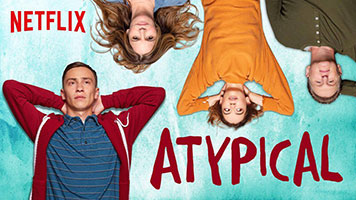
5. Atypical (Netflix, 2017-2021)
Atypical has its critics in the autism community, and some of those criticisms are fair. Early seasons were also criticized for not casting an autistic actor in the lead role. The show’s protagonist, Sam, played by Keir Gilchrist, is written with some behaviors that many autistic viewers found exaggerated or inaccurate, particularly early on.
But Atypical earned its place on this list by going somewhere most autism storylines don’t. It takes seriously the experience of being a teenager with ASD, including the specific challenges of dating, sexuality, and social navigation that come with adolescence. Sam’s obsessions, his literal thinking, his discomfort with change. These aren’t just quirks for comedic effect. They shape his relationships and his choices in ways that ring true.
The show also handles the family dynamics thoughtfully. Sam’s parents, sister, and friends each carry their own complicated feelings about his diagnosis, and those complications are portrayed honestly rather than resolved too quickly.
6. Temple Grandin (HBO, 2010)
This HBO biopic brings real-life professor and animal scientist Temple Grandin to the screen, with Claire Danes delivering a performance that won the Emmy for Outstanding Lead Actress in a Limited Series. Grandin, who is autistic, became one of the most influential figures in livestock handling practices and one of the most prominent autism advocates in the world. Her story is remarkable, and Danes does it justice.
What makes the film particularly effective is its visual approach. The filmmakers used deliberate cinematography to show how Grandin processes information, including her famous ability to think in pictures. You’re not just watching a biopic about an autistic person. You’re getting a genuine attempt to represent autistic cognition on screen.
7. The Bridge (2011)
The original Danish-Swedish series The Bridge is a dark Scandinavian crime drama, not a story about autism. That’s exactly what makes it so interesting.
The female lead, Saga Norén, displays traits that many viewers and critics have interpreted as consistent with autism throughout the series. But the show never explicitly names her diagnosis, and it never makes her condition the focus of the narrative. Her traits aren’t a plot device or a source of quirky humor. They inform how she communicates, how she reads other people, and how she approaches investigations, but they don’t define her or limit her.
That’s rare. Most fictional portrayals of autism treat the condition as the central fact about a character. The Bridge treats it as one aspect of a fully developed person. The show has been adapted in the United States, Russia, and other countries, and in each version, the same approach holds.
Frequently Asked Questions
Why are accurate autism portrayals in film and TV still rare?
Accurate portrayals require research, time with the autism community, and a willingness to let autistic characters be complex rather than just illustrative. Many productions skip that work and default to familiar tropes: the savant, the tragedy, the comic relief. The films on this list succeeded because the filmmakers or actors went beyond the surface.
Is Rain Man still considered an accurate portrayal of autism?
Rain Man is widely regarded as an emotionally compelling portrayal inspired by Kim Peek, the real-life savant whose abilities shaped the character. As a portrayal of autism broadly, it’s more limited. The film contributed to the widespread misconception that all autistic people are savants, which they aren’t. It’s still worth watching for its emotional honesty, but it’s best understood as one person’s story rather than a representative depiction of ASD.
Are there TV shows with autistic characters played by autistic actors?
Representation both on screen and behind the camera has improved in recent years. Some productions have made deliberate efforts to cast autistic actors or bring autistic writers and consultants into the creative process. It’s a growing conversation in the industry, and one worth following if authentic representation matters to you.
How does ABA therapy connect to the challenges shown in these films?
Applied behavior analysis is one of the most widely used and evidence-supported approaches for working with individuals on the autism spectrum. The family stress, communication challenges, and behavioral complexities depicted in films like Fly Away and Atypical are exactly the kinds of situations ABA practitioners work with every day. If you’re drawn to this work because of what you’ve seen on screen, that instinct is worth exploring. You can explore top ABA master’s programs to see what training and certification in the field looks like.
Key Takeaways
- Rain Man opened the door — but also created lasting misconceptions about savant abilities being universal among autistic people.
- The best portrayals share a common approach — direct research, time with the autism community, and complexity over caricature.
- Fly Away and What’s Eating Gilbert Grape — stand out for portraying the caregiver experience honestly, not just the autistic character’s perspective.
- The Bridge treats autism differently — as one aspect of a fully developed person rather than the central fact of the story.
- Atypical is imperfect but important — it explores the specific challenges of adolescence on the spectrum, which most portrayals avoid entirely.
Ready to learn more about the field working to improve outcomes for people with ASD? Explore ABA programs that train practitioners to work directly with autistic individuals and their families.