Quick Answer
Forrest Gump was never given an official diagnosis in the film. He’s shown with an IQ of 75, treated as a disability, though the movie never establishes a clinical intellectual disability diagnosis. Many autism researchers and ABA professionals have noted that his behaviors mirror autism spectrum traits: intense focus, social literalness, repetitive routines, and pattern-based skills. He likely reflects both.


If you’ve ever watched Forrest Gump and felt a flash of recognition, not just as a movie fan, but as a parent, a therapist, or someone who loves a person on the spectrum, you’re not alone. That reaction is common enough that people have been writing about it for years.
Forrest isn’t an autism diagnosis waiting to happen. He’s a fictional character written before autism was widely understood, and there’s no evidence Winston Groom set out to write an autistic character. But the traits that came through in the novel and in Tom Hanks’s performance overlap with autism spectrum disorder (ASD) in ways that resonate deeply with families and ABA professionals alike.
So let’s actually answer the question.
What Did Forrest Gump Have?
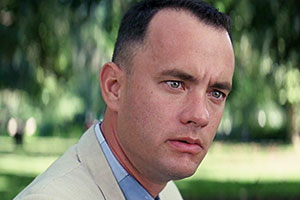
In the film, Forrest is described as having an IQ of 75 and wearing leg braces as a child due to a spinal condition. An IQ of 75 can indicate significant limitations in intellectual functioning, but a full intellectual disability diagnosis also requires deficits in adaptive functioning, something the film never assesses. His mother works hard to get him into mainstream schooling despite the school’s IQ cutoff.
The word “autism” never appears in the movie. Director Robert Zemeckis and author Winston Groom have never said Forrest was autistic. When Groom wrote the novel in 1986, autism was far less publicly understood, and the modern DSM-5-TR framework we use today did not yet exist.
That said, versions of this argument go back decades: informal analyses circulating online claim that applying DSM-IV criteria to the character, as depicted in the novel, would support a diagnosis of autistic disorder. We couldn’t verify these as peer-reviewed research, so treat this as a long-running popular argument rather than a clinical finding.
So the honest answer is this: Forrest was written as a character with a low IQ and a physical disability requiring leg braces, not a diagnosed intellectual disability or autism. But the traits that make him feel so familiar to the autism community are real, intentional, and worth examining.
The Autism Traits That Feel So Familiar
When ABA professionals watch Forrest Gump, certain scenes land differently than they do for a general audience. Here’s what stands out.
Literal interpretation of language
When his drill sergeant tells him he’s a “goddamn genius” for answering a direct question directly, Forrest takes the compliment at face value. He doesn’t pick up on sarcasm. He doesn’t read the room. He answers what was asked, exactly as asked, and it works out beautifully, which is part of the joke. But for people who work with autistic individuals, it’s also deeply recognizable.
Exceptional focus in structured environments
Give Forrest a clear task with clear rules, and he excels. Table tennis is the clearest example. Told to never take his eye off the ball, he never does, not once, through relentless practice. That isn’t stupidity. That’s the kind of singular, almost meditative focus that shows up frequently in people on the spectrum, particularly when the activity has predictable rules and measurable outcomes.
Repetitive behavior channeled into extraordinary achievement
Forrest runs. Not because he has a training plan, but because running is what he does. It starts as a way to escape bullies as a kid, on Jenny’s instruction, and years later becomes a cross-country journey that captures national attention. ABA therapists may work to channel certain repetitive behaviors into functional or goal-directed activities when appropriate. Forrest never had that kind of clinical guidance, he found his own outlet.
Social obliviousness that isn’t unkindness
Forrest isn’t mean. He isn’t calculating. He just doesn’t read social dynamics the way most people do. He forms deep attachments to Jenny, to Bubba, to Lieutenant Dan, and is completely loyal within those relationships. But the broader social landscape, the subtext, the unwritten rules of what you’re supposed to say in a given situation, mostly pass him by.
These traits don’t make Forrest autistic by modern diagnostic standards. But they explain why many in the autism and ABA communities have informally embraced him.
What ABA Professionals Notice
Applied behavior analysts who work with autistic clients often recognize something in Forrest’s journey that goes beyond the character traits. They recognize the interventions.
His mother functions as a de facto behavior support specialist throughout his childhood. She reframes his differences as strengths (“stupid is as stupid does”). She finds environments where his focus is an asset rather than a liability. She pushes for mainstreaming when the system wants to exclude him, giving him a foundation to build on long after she’s gone.
That’s not clinical ABA. But the underlying logic is familiar: meet the person where they are, build on what works, and don’t let a label become a ceiling.
The relationship between Forrest and his various mentors: his drill sergeant, his ping-pong coach, Bubba’s shrimping knowledge, also reflects something ABA professionals know well. Structured environments with clear expectations bring out the best in people who struggle with ambiguity. Forrest doesn’t need less structure. He needs the right structure.
If stories like Forrest’s are part of what drew you to this field, you might want to check out the schools that made our top list and see what a career in applied behavior analysis actually looks like.
Why This Question Still Matters
People have been asking whether Forrest Gump is autistic for thirty years, and the question isn’t going away. That’s worth thinking about for a moment.
Part of it is that the film came out at a cultural inflection point. Autism diagnoses rose sharply through the 1990s, alongside expanded diagnostic criteria, improved screening, and increased awareness. Families who had never heard the word “autism” in 1994 were hearing it constantly by 2000. When they looked back at Forrest, a character they’d loved who’d made them laugh and cry, they saw their child’s behaviors reflected back at them. That’s powerful.
Part of it is also that Forrest Gump represents something important about how we talk about neurodivergence. He’s not a cautionary tale. He’s not a tragedy. He’s a person who leads a full life, forms deep relationships, serves his country, builds a business, and becomes a father. His differences are part of him, not a cage.
For a community that has fought hard against deficit-based narratives about autism, Forrest’s story, whatever diagnosis you apply to it, lands differently than most Hollywood portrayals.
Frequently Asked Questions
Was Forrest Gump officially diagnosed with autism in the movie?
No. The film never uses the word autism. Forrest is described as having an IQ of 75, though the movie never establishes a clinical intellectual disability diagnosis, that would also require deficits in adaptive functioning. However, many researchers and ABA professionals note that his behavioral traits closely align with autism spectrum characteristics, including social literalness, intense focus, and repetitive behaviors.
What is the difference between intellectual disability and autism?
These are distinct conditions that can co-occur. Intellectual disability refers to significant limitations in both intellectual functioning and adaptive behavior. Autism spectrum disorder requires persistent differences in social communication and interaction, along with restricted or repetitive behaviors and interests, which can include sensory sensitivities. A person can have both, either one, or neither.
Did the author of Forrest Gump intend the character to be autistic?
There’s no evidence that Winston Groom wrote Forrest with autism in mind. The novel was published in 1986, when autism was far less publicly understood, and the modern DSM-5-TR framework didn’t exist yet. Groom has not commented publicly on the autism interpretation of his character.
Why do so many autism families connect with Forrest Gump?
The traits Forrest displays, including social literalness, exceptional focus in structured situations, deep loyalty within close relationships, and repetitive behaviors channeled into extraordinary outcomes, reflect real experiences that many autistic individuals and their families recognize. The film also portrays Forrest with warmth and dignity, which resonates with a community that is often underrepresented in media.
What does ABA therapy have to do with Forrest Gump?
Applied behavior analysts who work with autistic clients often recognize in Forrest’s story the same principles that guide ABA practice: building on strengths, using structure to support success, and redirecting behaviors into positive outcomes. Forrest’s mother, in particular, demonstrates many of the supportive strategies that inform modern ABA approaches.
Key Takeaways
- Forrest was written as a character with a low IQ and a physical disability, not a diagnosed intellectual disability or autism — though the two can co-occur, and his behavioral traits overlap significantly with autism spectrum characteristics.
- A popular argument, repeated for decades online, claims Forrest would meet DSM-IV criteria for autistic disorder based on the novel, though we couldn’t verify this as peer-reviewed research.
- Four core traits drive the autism community’s connection to Forrest: literal language interpretation, exceptional task-specific focus, repetitive behaviors, and social obliviousness without unkindness.
- ABA professionals often recognize familiar principles in Forrest’s story — structured environments, strength-based framing, and behavioral redirection toward meaningful outcomes.
- Forrest Gump matters to the autism community in part because he’s portrayed as a full human being, not a diagnosis, which remains rare and meaningful in popular culture.