
Pivotal Response Treatment (PRT) is a naturalistic, play-based ABA method that targets “pivotal” behaviors (like motivation and self-initiation) that, once improved, create positive ripple effects across many other areas of a child’s development. Developed by Dr. Lynn and Robert Koegel, PRT is one of the most research-supported naturalistic approaches within ABA therapy for autism.


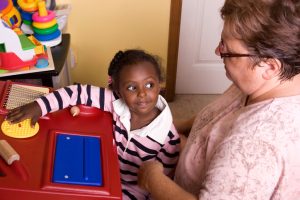
If you’ve ever watched a child with autism struggle to say a single word, you know how much weight a moment like that carries. For the Facente family, three years passed before their son Tristan, who has autism, spoke his first word. It wasn’t until they worked with Dr. Lynn Koegel, co-developer of Pivotal Response Treatment® (PRT), that he finally said “tickle” during a therapy session featured on the TV show Supernanny.
That moment captures exactly what PRT is designed to do: use natural, child-led interactions to unlock communication and behavior skills that other methods sometimes can’t reach.
What Is Pivotal Response Treatment?
PRT is a naturalistic teaching approach rooted in applied behavior analysis. The name comes from the idea that some behaviors are “pivotal,” meaning that improving them doesn’t just change one isolated skill, it creates positive change across many areas of development at once.
The method was developed at the University of California, Santa Barbara, by Dr. Lynn Koegel and Dr. Robert Koegel through the Koegel Autism Center. It’s based on decades of research suggesting that targeting areas like motivation, self-initiation, responsiveness to multiple cues, and self-management can produce broad gains for children with autism.
Rather than drilling isolated skills in a structured setting, PRT happens within natural play and conversation. The child’s interests drive the session. The therapist follows the child’s lead, embeds learning opportunities in activities the child already enjoys, and rewards genuine attempts to communicate, not just correct responses.
How PRT Aligns with Applied Behavior Analysis
PRT doesn’t sit apart from ABA. It’s one of the most direct applications of ABA principles in practice. ABA is guided by core dimensions outlined in behavioral science literature, including systematic application, grounding in learning theory, socially meaningful goals, and measurable demonstration of behavior change. PRT aligns closely with these core dimensions of ABA practice.
Here’s how each one plays out with PRT.
Applying interventions systematically. When Dr. Koegel worked with Tristan, she didn’t just hope he’d say “tickle.” She designed a structured sequence: she tickled him repeatedly while saying the word, then paused and waited. Tristan filled in the blank. She immediately rewarded him by tickling him again. That repetition and precise timing is the systematic application ABA requires.
Basing interventions on learning theory. PRT draws on self-directed and experiential learning principles. A key part of the method is letting children choose their preferred materials and activities. That choice itself builds motivation. When a child is working toward something they actually want, their willingness to engage increases. The reward isn’t arbitrary. It’s the natural outcome of the interaction.
Targeting behaviors that are meaningful. PRT doesn’t aim to teach a single word or a single game. It aims to build skills that transfer. Teaching a child to play Bingo, for instance, doesn’t just teach Bingo. It builds listening, turn-taking, verbalizing, and peer interaction, all at once. That’s the point: meaningful gains that show up in real life, not just in a therapy room.
Demonstrating measurable behavior change. Is there actual evidence that PRT works? Yes. A review by the National Professional Development Center on Autism Spectrum Disorders identified multiple controlled studies supporting PRT as an evidence-based practice. That’s the kind of research base that gives clinicians and families confidence in the approach.
What to Realistically Expect from PRT
PRT has a strong research record. But it’s worth being direct about what that means for any individual child.
The Facente family’s experience with Tristan shows both the promise and the complexity. His first word during that Supernanny episode was a genuine breakthrough. And yet by 2013, when he was in middle school, his mom was reaching out publicly again, noting that “abstract things like feelings and emotions are very hard for him to understand and communicate.” He needed a different kind of ABA support at that stage of his life.
That’s not a failure of PRT. It’s a realistic picture of what autism intervention actually looks like long-term. A child’s needs change. A method that produces strong results at age three may not be the primary approach at age twelve. PRT is one tool, and an effective one, but it works best as part of a broader, evolving treatment plan.
No single method is a permanent solution. The most effective ABA programs combine approaches, adjust over time, and keep the individual child’s current needs at the center.
Frequently Asked Questions
What does “pivotal” mean in Pivotal Response Treatment?
In PRT, “pivotal” refers to behaviors that, when improved, lead to widespread positive changes across many other skills. Motivation and self-initiation are two of the most important pivotal areas because gains there tend to generalize to communication, social interaction, and learning readiness, all at once.
Who developed Pivotal Response Treatment?
PRT was developed by Dr. Lynn Koegel and Dr. Robert Koegel at the University of California, Santa Barbara’s Koegel Autism Center. Dr. Lynn Koegel has been one of the leading voices in naturalistic ABA intervention for decades, and the method is now used by behavior analysts and therapists worldwide.
Is PRT the same as ABA?
PRT is a specific method that operates within the broader framework of ABA. All PRT is ABA, but not all ABA is PRT. ABA encompasses many approaches, including Discrete Trial Training, Functional Communication Training, and naturalistic teaching, among others. PRT is distinguished by its naturalistic, child-led structure and its focus on pivotal behavioral targets.
Is Pivotal Response Treatment evidence-based?
Yes. A review by the National Professional Development Center on Autism Spectrum Disorders identified multiple controlled studies supporting PRT as an evidence-based practice. It is among the well-researched naturalistic ABA approaches available.
When is PRT most commonly used?
PRT is most commonly used with young children, particularly in early childhood intervention. That said, the core principles (motivation, child-led learning, natural reinforcement) can be applied across age ranges. Clinicians often adjust the implementation as a child’s developmental needs change over time.
Key Takeaways
- PRT targets pivotal behaviors — like motivation and self-initiation — that, when improved, produce broad gains across communication, social skills, and learning readiness.
- It was developed by Dr. Lynn and Robert Koegel at UC Santa Barbara and is backed by multiple controlled studies meeting evidence-based practice criteria.
- PRT follows the child’s lead, embedding learning in natural play and rewarding genuine attempts to communicate — not just correct responses.
- It aligns closely with core principles of applied behavior analysis, including systematic intervention, grounding in learning theory, socially meaningful targets, and measurable outcomes.
- No single method is a permanent solution. PRT works best as part of a broader, evolving treatment plan that adjusts to a child’s changing needs over time.
Ready to learn more about ABA therapy methods and career paths in behavior analysis? Explore accredited ABA programs and find the right fit for where you want to take your career.